
Investing in Dubai holiday homes: a guide for UK investors
Dubai has become a serious investment destination for UK property owners, and the momentum behind that shift is not slowing down.
The combination of strong yields, a tax-efficient environment, and a market that is actively expanding rather than legislating against short-term letting makes it a compelling case, particularly for investors who have watched the UK buy-to-let model become increasingly difficult to make work.
Seasoned landlords looking to diversify and first-time investors evaluating where to put their capital are both arriving at the same conclusion: the serviced accommodation opportunity in Dubai is worth examining carefully.
This is not a general introduction to Dubai real estate. It is a specific look at why the short-term, managed accommodation model is where the strongest risk-adjusted returns are being generated, and what UK investors need to understand before committing capital.
If you’re looking for a broader overview of the topic, our complete guide to Dubai holiday home investment covers everything you need to know.
Why Dubai, and why now
The Dubai of 2026 is structurally different from previous cycles. The regulatory infrastructure has been substantially upgraded. The Dubai Land Department and RERA have created a transaction framework that gives foreign buyers genuine legal protection.
The Department of Economy and Tourism (DET) has formalised the holiday home sector through a licencing regime that regulates operators and sets quality standards. This is a formalised, mature industry, not an unregulated side market.
For UK investors, the contrast with the domestic environment is striking. Where the UK has introduced successive layers of additional cost and complexity for property investors, including the loss of mortgage interest relief, the Renters’ Reform Bill, and rising EPC compliance requirements, Dubai is moving in the opposite direction.
The regulatory posture actively supports the short-term letting model, and that tailwind is a meaningful part of the investment thesis.
The short-term rental market in Dubai has grown substantially and consistently. Dubai welcomed over 17 million international visitors in 2023, with further growth projected.
The guest mix is diverse: leisure tourists, business travellers, corporate relocators, and long-stay visitors who prefer apartment-style accommodation over hotels.
That diversity means demand is resilient across seasonal cycles and not dependent on any single visitor segment.
The yield story
UK investors are accustomed to working hard to extract decent returns from residential property, and Dubai’s numbers deserve direct attention.
Rental yields in Dubai for well-managed short-term accommodation regularly sit between 6% and 10% gross in the city’s most active areas. In prime London, the equivalent figure on a long-term tenancy rarely exceeds 3 to 4%, and that is before accounting for the tax drag that has intensified since Section 24 came into full effect.
The gap is substantial, and it widens further when you factor in that the UAE levies no income tax and no capital gains tax on property for individual investors.
Holiday home investment in Dubai has the further advantage of operating within a regulated framework.
Once a property holds a DET holiday home licence in Dubai, it can be listed on Airbnb, Booking.com, and other major platforms entirely legally, with the management company handling compliance, guest registration, and all operational requirements.
For UK investors comparing this against a residential property generating rental income at home, the yield differential is significant.
The combination of better returns, AED currency exposure (pegged to the USD), and capital appreciation potential in a market with sustained structural demand makes the investment case compelling.
Estimate your property’s potential
Use our estimate widget to quickly gauge the rental potential of your property. Simply enter the address and the number of bedrooms, and get an instant estimate to help you make informed decisions about your investment.
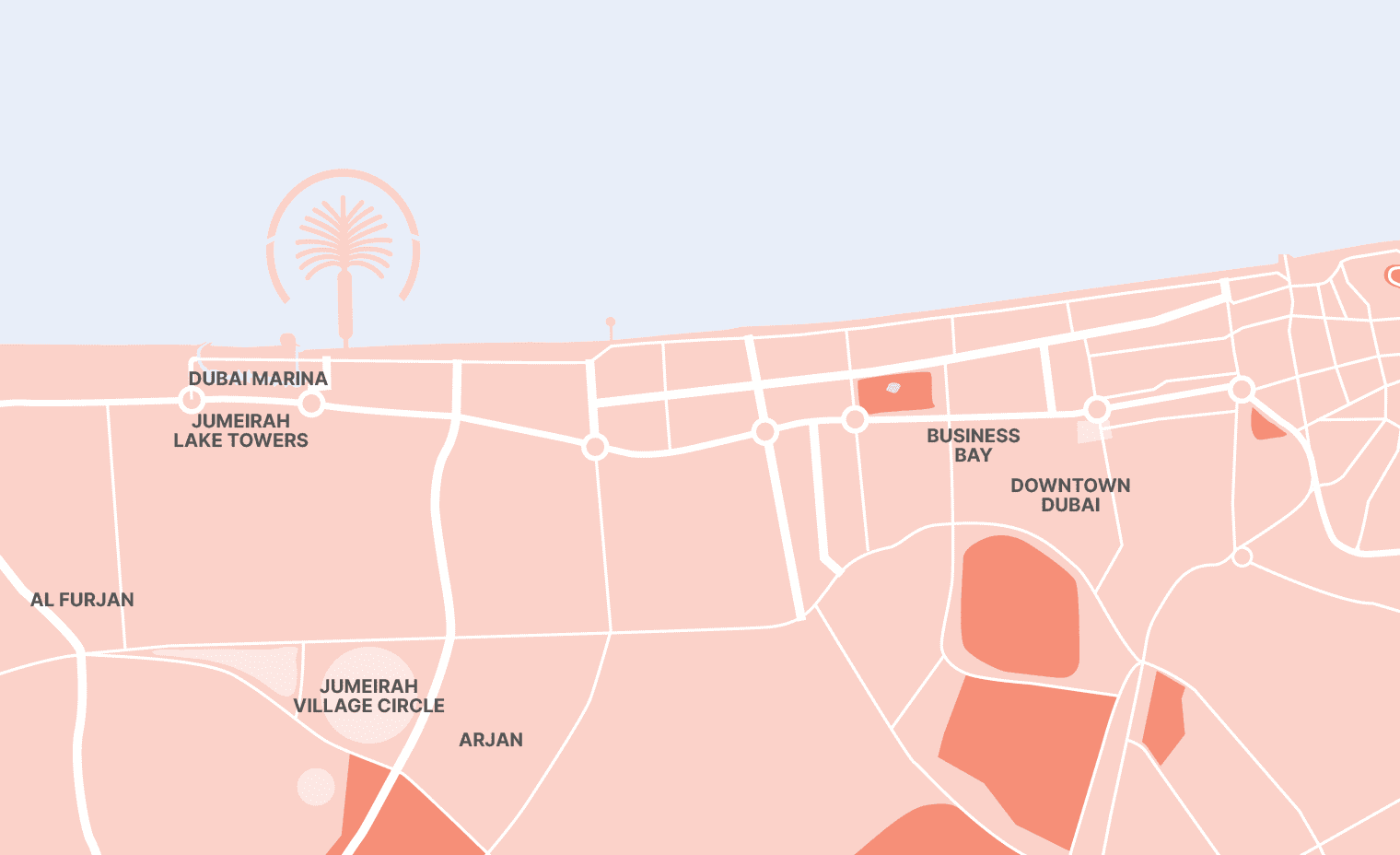
Best areas for Dubai holiday home investment
Location selection within Dubai makes a substantial difference to performance. The city is large and varied, and not all areas are equally suited to the short-term accommodation model.
- Dubai Marina consistently ranks among the top-performing areas for serviced accommodation. The waterfront setting, density of restaurants and leisure facilities, and beach proximity through JBR create strong appeal for leisure visitors and short-stay corporate guests alike. Nightly rates are premium, occupancy is robust year-round, and the area is well-established in the minds of international visitors.
- Downtown Dubai and Business Bay attract a corporate and upscale leisure mix. The proximity to DIFC means consistent demand from the financial services sector. Average daily rates here tend to be higher than most other areas, with a guest profile that aligns well with the corporate let model.
- Palm Jumeirah commands the city’s highest nightly rates. Acquisition costs are higher, which compresses yield percentages relative to Marina or Business Bay, but the sustained international prestige of the address and strong long-term demand make it a sound hold for investors with a larger budget who are also drawn to personal use of the property.
- Jumeirah Village Circle offers an accessible entry point with solid yields. The area has developed substantially, the amenities base has improved, and the guest profile, often medium-stay corporate travellers and relocators, creates stable occupancy patterns.
Buying as a UK national: what you need to know
Purchasing property in Dubai as a UK national is straightforward. Foreign nationals can purchase freehold property across designated freehold areas with full ownership rights, and the transaction process handled through the Dubai Land Department is well established and transparent.
The key decisions are around ownership structure.
Purchasing in personal name is the most common approach for individual investors. Corporate ownership through a UAE or offshore structure is also used, particularly where investors are managing larger portfolios or have specific estate planning requirements.
A UAE-based lawyer or financial adviser familiar with international investor structures can advise on the most appropriate approach for your situation.
For UK investors, the tax picture requires careful planning. HMRC requires UK tax residents to declare worldwide income, which includes rental income from Dubai properties.
The double taxation treaty between the UK and UAE applies, but the mechanics depend on how the income is structured and received.
Taking advice from an accountant experienced in cross-border property investment before purchase is not optional; it is essential.
The UAE Golden Visa: an important consideration
For UK investors purchasing above AED 2 million (approximately £430,000 at current rates), the UAE Golden Visa is worth understanding.
A qualifying property investment gives the holder a 10-year UAE residency visa, which has implications beyond simply the right to reside.
It opens access to UAE banking and business registration, and for some investors, creates a pathway to a more formalised UAE presence over time.
For UK investors who travel regularly to Dubai for business or who are considering a longer-term lifestyle shift, the Golden Visa provides a stable legal foundation for a growing Dubai property portfolio.
Serviced accommodation vs. long-term letting
This is a question worth addressing directly, because some investors default to long-term letting as the more familiar model.
Long-term letting vs. short-term rental in Dubai produces very different income outcomes. A two-bedroom apartment in Dubai Marina let on a standard annual tenancy might generate AED 120,000 to 150,000 per year.
The same property, professionally managed as a serviced accommodation unit and listed across major booking platforms, can generate AED 200,000 to 280,000, and sometimes more in high-demand periods.
The management burden is higher for short-term accommodation, which is why professional management is essential. The net income after management fees, cleaning, and platform commissions still comfortably exceeds the long-term rental alternative in most scenarios.
Serviced accommodation vs. hotels is also a useful frame of reference. Serviced apartments occupy a specific niche: they offer hotel-quality service and management standards, but with the space, privacy, and kitchen facilities that apartment-style accommodation provides.
This format is particularly popular with corporate visitors on extended stays, and with international families who want more than a standard hotel room can offer.
What professional management looks like
For UK investors who are not resident in Dubai, a specialist operator handles everything. The ability to generate strong returns from a market several thousand miles away, without day-to-day involvement, is precisely what makes this model viable for investors based in the UK.
What a serviced accommodation management company does covers the full operational picture: 
- DET holiday home licensing in Dubai
- Listing creation and optimisation across Airbnb, Booking.com, and direct booking channels
- Dynamic pricing calibrated to Dubai’s specific demand calendar
- 24-hour guest communication
- Professional housekeeping after every checkout
- Maintenance coordination
- Monthly performance reporting with clear revenue and occupancy data
GuestReady’s Dubai property management operation covers the city’s key short-term rental areas, with local teams managing every aspect of the operation.
The best property management companies in Dubai differentiate themselves through pricing intelligence, guest experience quality, and the consistency of their operations, all of which show up directly in occupancy rates and review scores.
Estimate your property’s potential
Use our estimate widget to quickly gauge the rental potential of your property. Simply enter the address and the number of bedrooms, and get an instant estimate to help you make informed decisions about your investment.
Off-plan opportunities for UK investors
The Dubai market includes a significant volume of off-plan property investment specifically designed with short-term letting in mind.
Developers increasingly build in features that appeal to the serviced accommodation guest: hotel-quality finishes, lobby services, pool and gym facilities, and in some cases direct partnerships with management companies.
For UK investors who want to allocate capital progressively over two to three years, paying 10 to 20% on exchange and the remainder through staged construction payments, off-plan can be an efficient entry strategy.
The key is working with established developers and understanding the escrow protections now in place through RERA, which ensure development funds are ringfenced and the project is completed as contracted.
Let’s talk about your investment
UK investors making their first Dubai property purchase and those who already own in the city and want to understand whether switching to managed short-term letting would improve their returns will both find GuestReady a useful starting point.
Our team works with UK investors across the full investment journey, covering area selection and purchase advice, management setup, and ongoing performance optimisation.
GuestReady is a leading short-term rental management company operating in Dubai, the UK, France, Portugal, and Spain. We help property owners maximise returns while providing guests with exceptional stays.
Complete the form below and a member of our team will be in touch within one business day.