Landlord’s guide: Short-term lets in London
Last updated: September 7, 2026
A short-term rental in London is a furnished residential stay of fewer than 90 consecutive nights, most commonly booked through platforms like Airbnb or Booking.com. Under London planning law, Whole-property short lets are capped at 90 nights a calendar year, a mandatory national registration scheme goes live next March, and tax rules have shifted following the abolition of the furnished holiday lettings regime.
Short-term rentals in London: the basics
A short-term rental, or short let, is a furnished residential occupancy of fewer than 90 consecutive nights that includes utility bills, broadband, and furnishings in the headline rate. To list a London property on Airbnb, Booking.com, or Vrbo, the property must be fully furnished and equipped before the first guest arrives.
Most London short lets fall into one of two groups: a spare room or whole flat let out around a landlord’s own life (holidays, business trips, a gap between long-term tenants), or a dedicated investment property let short-term full time. The rules and the maths differ for each, and this guide focuses mainly on the second group, since that’s where the compliance stakes, and the choice of manager, matter most.
Self-manage, co-host or hire an agency for your London property
Most first-time London landlords choose between three routes: running the listing themselves, sharing the workload with a co-host, or handing the property to a local management company. The right call comes down to how much time you actually have, how comfortable you are carrying the compliance risk yourself, and whether you’d rather keep all the income or trade a share of it for someone else doing the work.
Managing it yourself
Self-managing means you own every part of the operation: the listing and pricing, guest messages around the clock, check-in and check-out, cleaning between stays, and fixing whatever breaks. It’s the highest-margin option, and the most realistic one if you live close to the property, enjoy the guest-facing side of hosting, and can genuinely be reachable at short notice.
It’s a poor fit if you travel for work, live outside London, or already know that evenings spent answering guest messages isn’t something you want long-term.
Co-hosting with a friend, family member or professional co-host
A co-host shares the day-to-day guest-facing work, usually for a fee or a share of the booking income, while you keep ownership and final say. This suits landlords who want to stay hands-on with pricing and guest selection but need someone local to cover check-ins, cleaning, or emergencies.
Choose a co-host who speaks the language your guests book in and who you’d trust with a set of keys, since Airbnb gives them access to guest communication and, usually, the property itself.
Hiring a London Airbnb management company
A management company takes over pricing, guest communication, cleaning, maintenance and compliance in exchange for a commission on your rental income, so you’re not the one fielding a message about a broken boiler at 2am.
GuestReady’s London team, led by Chris Mitchell, currently manages properties for 300+ London hosts at an average occupancy rate of 85%, with fees starting from 12% of rental revenue. That commission doesn’t buy you a black box: the GuestReady owner dashboard tracks bookings, revenue, occupancy and payouts in one place, so you can check how the property’s performing wherever you are, without having to chase anyone for an update.
“After switching to GuestReady, most landlords feel the difference from day one. It usually takes about a week from signing to going live, and by then we’ve sorted the professional photography, set up and distributed the listing, and got the pricing right. From there, we’re answering guests 24/7 and making sure the property stays compliant, including with the 90-day rule.
By delegating to us, you get your time back, plus real-time transparency on how your property’s performing, from wherever you are.” – Chris Mitchell, Country Manager UK & Ireland.

Self-manage, co-host or hire an agency: how the three options compare
| Approach | Your time each week | Who carries compliance risk | Typical cost | Best for |
|---|---|---|---|---|
| Self-manage | High: messages, cleaning and admin are all yours | You | No commission, but your own time has a cost | Landlords living near the property with time to spare |
| Co-hosting | Medium: you still set strategy and cover what your co-host can’t | Shared, though usually still you as registered host | A fee or income share agreed with your co-host | Landlords who want to stay hands-on but need local cover |
| Management company | Low: the agency runs day-to-day operations | The landlord retains ultimate statutory liability; the management company carries operational responsibility for cross-calendar 90-day tracking, safety compliance coordination, and digital registration administration. | Commission on rental income (from 12% with GuestReady in London) | Landlords who travel, live outside London, or want the admin off their plate |
If you’d rather compare GuestReady directly against other operators, see our full breakdown of property management companies in London.
What a London property can realistically earn
London short lets typically earn more than an equivalent long-term tenancy, though the exact uplift depends heavily on the borough, the property type and how actively it’s managed. Across GuestReady’s own London portfolio, well-managed short lets earn up to 60% more than a comparable long-let, with average occupancy running around 85%.
Performance varies sharply by area. On GuestReady’s own London host data, Kensington & Chelsea and Notting Hill are currently the strongest-performing boroughs, averaging £241 a night at 82% occupancy; Camden averages £172 a night at 85% occupancy on music and events demand; and Canary Wharf’s £132 average nightly rate is propped up by steady midweek corporate bookings rather than weekend tourism.
See what your London property could earn
Use our estimate widget to quickly gauge the rental potential of your property. Simply enter the address and the number of bedrooms, and get an instant estimate to help you make informed decisions about your investment.
The amenities every London short-term rental needs
Guests booking a London short let expect the essentials of a serviced stay, not just a furnished flat, so a property needs these basics in place before it goes live on any platform (see GuestReady’s full amenities checklist for more):
- Wifi

- Iron and ironing board
- Hairdryer
- Microwave
- USB charging points
- Clean bed linen and towels
- Basic toiletries
- A fully equipped kitchen (kettle, toaster, basic cookware)
- Bin bags and cleaning products
Whoever manages the property, whether that’s you, a co-host or an agency, is also responsible for keeping it compliant with gas safety, electrical safety and smoke/carbon monoxide alarm regulations before the first booking, not just stocking the welcome basket.
London short-term rental rules in 2026
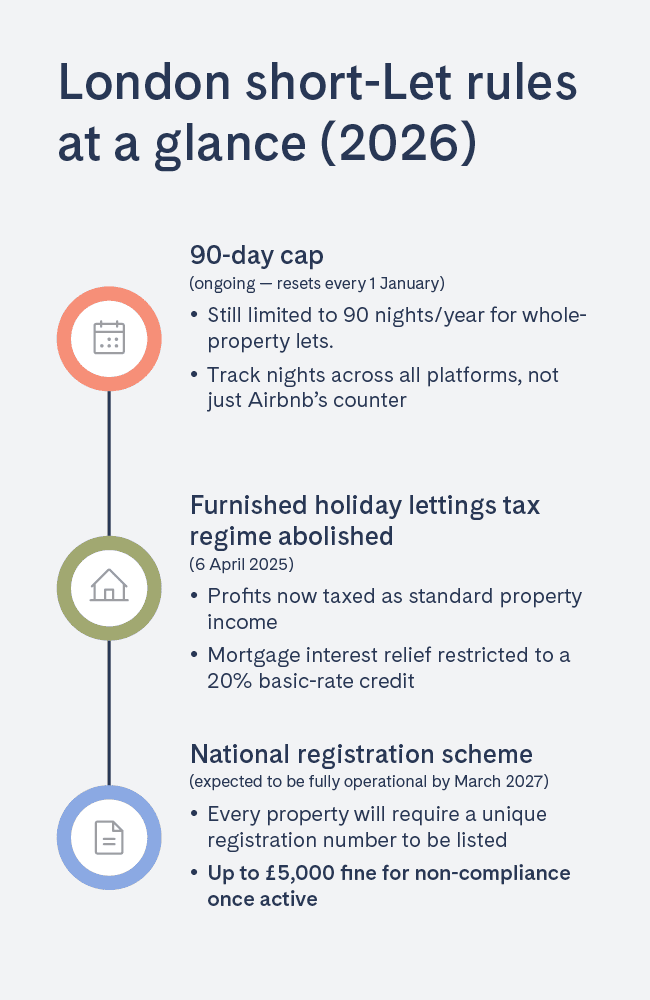
Three rules matter most for a London short let in 2026: the long-standing 90-night annual cap on whole-property lets, a new national registration scheme working towards a 2026 launch, and the removal of the old furnished holiday lettings tax advantage from April 2025. None of these are optional extras, and all three affect whether, and how profitably, you can operate.
The 90-day rule
In Greater London (covering all 32 boroughs and the City of London), letting a whole residential property for short stays is governed by Section 25 of the Greater London Council Act 1973. Under Section 44 of the Deregulation Act 2015, an exemption permits short-term letting without planning permission, provided two conditions are met: the cumulative nights let across the calendar year do not exceed 90, and the person providing the accommodation is liable to pay Council Tax on the premises.
The 90-night cap resets each 1 January, applies across all booking platforms combined, and does not apply to hosted stays where the resident host remains physically present in the property.
Airbnb enforces the cap automatically once you cross 90 nights on its own platform, but that counter doesn’t know about bookings taken through other channels, so cross-platform tracking is worth doing yourself, or handing to whoever manages the property. For the full breakdown, see GuestReady’s guide to the London 90-day rule.
The national short-term let registration scheme
England is preparing to introduce a mandatory national registration scheme for all short-term lets under powers legislated in Part 12 of the Levelling-up and Regeneration Act 2023. Administered by the Department for Culture, Media and Sport (DCMS), the digital system will require every short-let property to obtain a unique registration number before it can be advertised.
Culture Secretary Lisa Nandy has confirmed that the scheme will become fully operational from next March, following directives to accelerate its rollout. Under the system, property owners must register, submit property and host details, pay a registration fee, and obtain a unique registration number before listing or letting accommodation on platforms like Airbnb or Booking.com.
Local councils will gain direct access to this register, giving London boroughs the data needed to cross-reference booking activity and enforce the 90-day cap. Marketing an unregistered property once the scheme is mandatory will carry civil penalties of up to £5,000. If you currently self-manage or work with a co-host who does not handle compliance, registering the property in time for the March go-live will be your legal responsibility.
Furnished holiday lettings tax relief is gone
The furnished holiday lettings (FHL) tax regime, which used to let short-let landlords deduct mortgage interest in full and claim more generous capital allowances than standard buy-to-let landlords, was abolished from 6 April 2025 (HMRC).
Short-term rental income is now taxed as ordinary property income: mortgage interest relief is restricted to a 20% tax credit, and the capital gains and pension advantages FHLs used to carry no longer apply.
If your understanding of short-let tax still assumes the old FHL rules, it’s worth a conversation with an accountant before the next tax year, not after. See GuestReady’s guide to short-term rental tax for more detail.
Frequently asked questions
What is a short-term rental in London?
A short-term rental, or short let, is a furnished residential letting of less than six months, most commonly booked through Airbnb, Booking.com or Vrbo. Unlike a long-term tenancy, the price includes bills, wifi and furnishings, and the property must be fully set up for guests from the first night.
How many nights a year can I let my London property short-term?
Whole-property short lets in Greater London are capped at 90 nights per calendar year without planning permission. The limit resets on 1 January and applies across all booking platforms combined, not just Airbnb.
Should I use a letting agency or manage my short let myself?
It depends on your time, location and appetite for compliance admin. Self-managing keeps all the income but means you’re on call for guests, cleaning and the 90-day count yourself; a management company takes a commission in exchange for running all of that, including registration and licensing, for you.
Do I need to register my short-term let in London in 2026?
England’s national short-term let registration scheme is expected to become fully operational by March 2027, following a Parliamentary statement from Culture Secretary Lisa Nandy on 3 September 2026. Once live, every short-let property will need a registration number to be listed on any platform.
Is a short-term rental more profitable than a long-term let in London?
Often, yes, though the gap depends heavily on the borough and how actively the property is managed. Well-managed London short lets can earn significantly more than an equivalent long-term tenancy, but they also carry higher running costs (cleaning, utilities, void nights) and more regulatory admin than a standard tenancy.
How much does an Airbnb management company cost in London?
Management fees for London properties typically range from around 10% to 25% of rental revenue depending on service level, with GuestReady’s own London fees starting from 12% and varying by property and location.
Renting out a London property for the first time?
Whether you decide to self-manage, share the workload with a co-host, or hand it over entirely, the rules above apply either way, and getting them wrong is more expensive than seeking support. GuestReady’s London team already handles pricing, compliance, and the 90-day count for 300+ London hosts. Talk to GuestReady’s London team.