Best rental yields in London: the 2026 investor’s guide
Last updated: July 7, 2026
Most guides list London’s buy-to-let yields and stop there. The more useful question is how much a property could actually earn once you factor in how you let it, because in London a well-run short-term let can out-earn a standard tenancy per night. This 2026 guide covers the best rental yields in London: where they are, how buy-to-let compares with short-let, and the rules every investor should know first.
Estimate your property’s potential
Are you curious about how much your property could earn in London’s best rental yield areas? Use our estimate tool to quickly assess your property’s earning potential in the city’s most lucrative neighbourhoods. Enter your property details and get an instant estimate to help you make informed decisions and maximise your rental income in London.
The London rental market in 2026
The backdrop favours landlords. On the sales side, London is the softer end of the UK market, with average prices around £542,000 and broadly flat to slightly down over the past year (Land Registry data), which means more choice and room to negotiate.
The rental side is the opposite. According to the latest rental market report from Zoopla, the average new-let rent hit £1,321 in June 2026, there are around 25% fewer rental homes than before the pandemic, and 5.6 tenants now chase every available home. That supply squeeze is exactly what keeps rental income, and yields, resilient.
Where are the best rental yields in London?
The strongest buy-to-let yields sit in east and south-east London, where prices are lower but demand stays high. According to Track Capital, the top area is East Ham (E6) at around 6%, helped by heavy regeneration and strong five-year price growth. Other leading postcodes for yields above 5% include:
- East Ham (E6): around 6%
- Thamesmead (SE28): around 5.9%
- Stratford, West Ham (E15): around 5.8%
- Abbey Wood (SE2): around 5.8%
- Tottenham (N17): around 5.8%
- Plaistow, Upton Park (E13): around 5.7%
- Hackney, Homerton (E9): around 5.5%
- Bethnal Green, Shoreditch (E2): around 5.4%
- Dulwich (SE21): around 5.2%
- Upper Holloway, Archway (N19): around 5%
Yields move with prices and rents, so treat these as a recent snapshot and check current data before buying. Stratford deserves a special mention: its transport links and Olympic-Park setting also make it one of the better short-let prospects on the list.
Buy-to-let vs short-let: what London property really earns
This is where GuestReady’s view differs. A tenancy gives steady, predictable income; a short-term let is priced per night, and a well-run London listing can earn a real premium on the nights it is booked. Which wins? It depends, and the data does not all agree. Different trackers put London’s average short-let nightly rate between roughly £150 and £260, and median annual revenue for an unconstrained listing between about £42,000 and £50,000, so treat any single headline figure with caution. Here is how the top five compare.
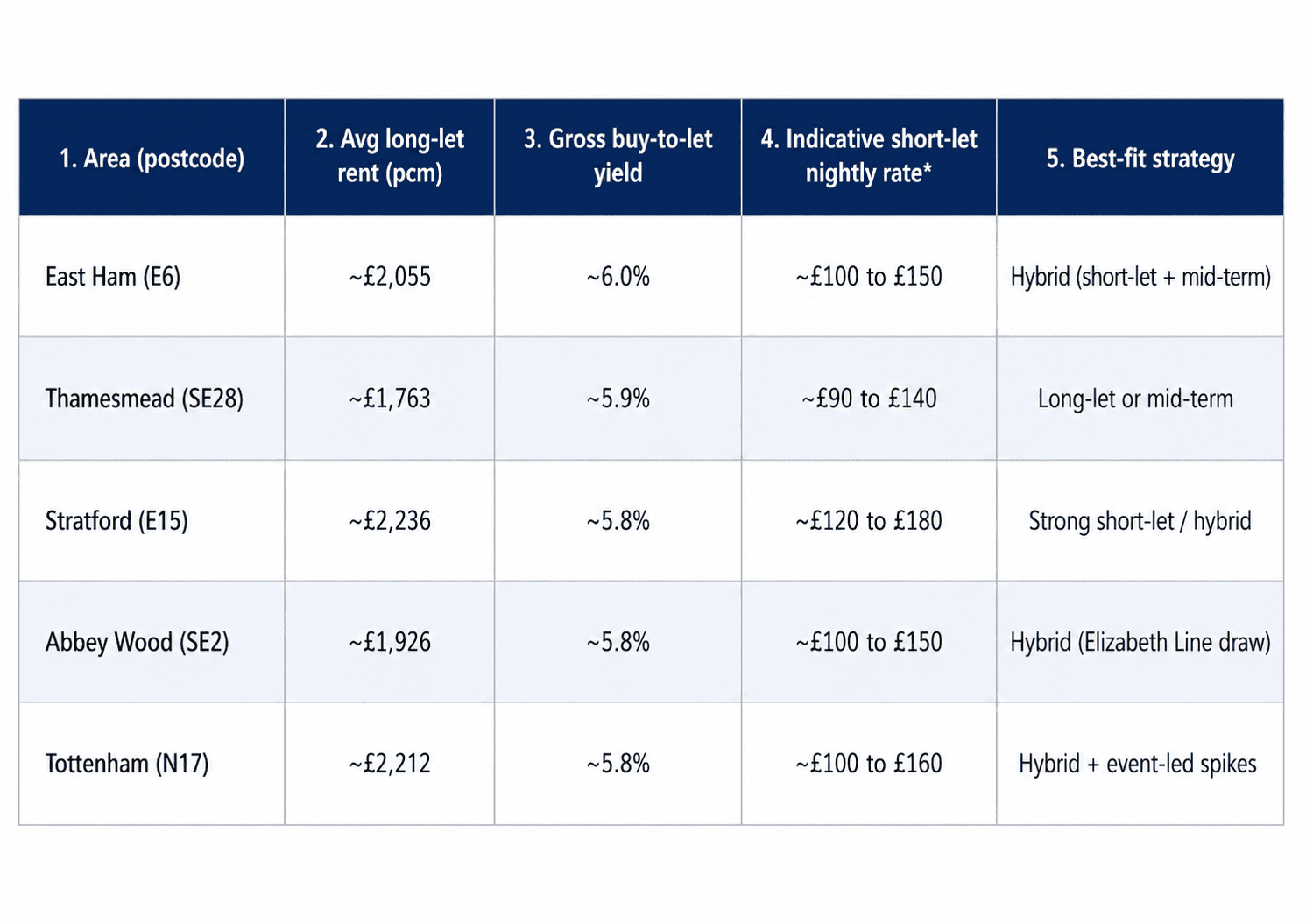
*Indicative ranges only, estimated from city-wide London nightly-rate data, not a guarantee or GuestReady managed-property figures. Rates vary by property, finish, season and demand. For your property, use the income estimate tool.
The 90-day rule, and why a hybrid model wins
There is a catch in London. Under the Deregulation Act 2015, you can let a whole property short-term for only 90 nights per calendar year without planning permission. The cap resets on 1 January and applies across all platforms combined, not just Airbnb. Our Airbnb 90-day rule guide explains it in full. The smart response is a hybrid model:
- Short-let in peak demand. Use your 90 nights when they pay the most: summer, major events and high-rate weekends.
- Mid-term let the rest of the year. A single booking of 90 or more consecutive nights counts as a tenancy, not a short let, so it sits outside the cap, ideal for relocating professionals and contractors.
That blend is exactly what GuestReady manages, across both Airbnb and short-term rental management and mid-term rental management. In London, the best yield usually comes from combining the two within the rules, not choosing one.
Is London a good investment in 2026?
On balance, yes, for clear reasons. Softer purchase prices give buyers more leverage than they have had in years. Chronic undersupply (far fewer rental homes than pre-pandemic) keeps rents and income firm. And London’s deep, long-term demand, with millions of jobs plus tens of millions of visitors a year, underpins both long-let and short-let strategies. One honest caveat: mortgage rates have eased from their 2022 to 2023 peaks but the near-term direction is uncertain, so build your numbers on the rate you can get today.
What is a good rental yield in London?
As a rule of thumb, a good gross rental yield in London is around 5% to 6%, roughly where the top postcodes land. Prime central areas can yield as little as 2% to 3%, because buyers there are chasing capital growth rather than income. Honestly, London is not where the highest UK yields are; northern regions like the North East offer more. What London adds is liquidity, long-run capital appreciation and a uniquely deep short-let market.

Tax on rental income in London
UK property attracts several taxes, and a few rules have recently changed in ways that matter for short-let investors. This is general information, not advice, so speak to a qualified tax professional about your own position.
- Stamp Duty Land Tax on purchase (thresholds changed in April 2025; higher rates usually apply to additional properties).
- Income Tax at 20% to 45%; individual landlords now receive mortgage interest relief only as a 20% basic-rate credit, not a full deduction.
- Short-let changes: the Furnished Holiday Lettings regime was abolished in April 2025, removing the old tax perks, and councils can now charge up to a 100% council tax premium on second homes.
- Capital Gains Tax may apply on sale, and buy-to-let assets fall within Inheritance Tax above available allowances.
Short, medium or long term?
London’s residential and academic areas suit long and mid-term lets, tourist and event-driven areas suit short lets, and many top-yielding outer postcodes reward a hybrid. GuestReady is a short-term and mid-term rental management company, handling 24/7 multilingual guest communication, pricing and listing optimisation, cleaning, maintenance and professional photography, so letting stays hands-off and profitable. Done well, a short-let or hybrid strategy can beat a standard tenancy while still letting you use the property yourself when you need it.
Are you investing in property in London? Let us know
Frequently asked questions
What is a good rental yield in London?
Around 5% to 6% gross. The highest-yielding areas are in east and south-east London, while prime central areas yield far less because buyers there prioritise capital growth.
Where are the best rental yields in London in 2026?
Per Track Capital, East Ham (E6, around 6%), Thamesmead (SE28, around 5.9%), and Stratford, Abbey Wood and Tottenham (each around 5.8%). Always check current figures before buying.
Is it worth buying to let in London?
For long-term investors, yes: softer prices plus a tight, undersupplied rental market make a reasonable case, even though yields are lower than in northern England.
How much can you make from Airbnb in London?
Estimates vary, with unconstrained listings reported at around £42,000 to £50,000 a year. But London caps whole-property short lets at 90 nights without planning permission, so most hosts run a hybrid. Use the GuestReady estimate tool for your property.
What is the average rent in London in 2026?
The UK average new-let rent was £1,321 in June 2026 (Zoopla); London sits well above that, with inner-London one-beds commonly £2,000 to £2,500 a month and outer London £1,400 to £1,800.
Can foreigners buy property in London?
Yes, there is no restriction. Non-residents may need a larger deposit (sometimes up to 40%) and face higher mortgage rates, so use a broker who handles international buyers.
What is the 90-day rule for Airbnb in London?
You can let a whole London property short-term for up to 90 nights per calendar year without planning permission, counted across all platforms combined. Beyond that you need change-of-use planning permission.