
Best rental yields in France: eight cities compared for 2026
Last updated: August 5, 2026
Rental yield tells you how hard a property’s rent works against its purchase price. It does not tell you whether the building needs €40,000 of work, the commune permits short-term letting, or how much tax you will pay.
All of those details (the data, the regulation, operating costs, and rental strategy) decide if a promising percentage survives contact with the real property..
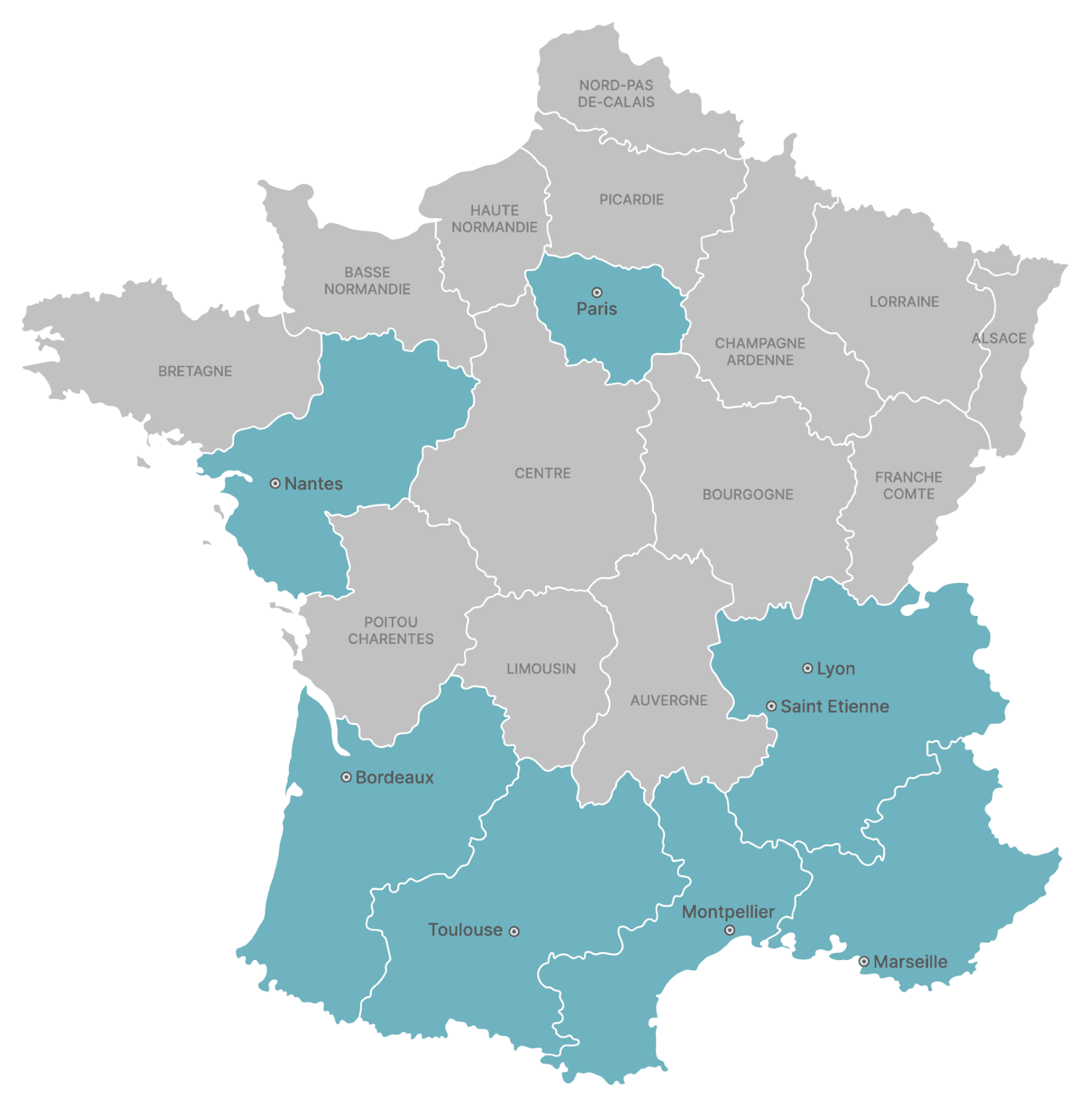
Among the eight large French markets covered by the latest dataset, Marseille has the highest average gross yield at 5.57%. Nantes follows at 5.20%, while Montpellier reaches 4.87%. These are long-term rental benchmarks, not projected Airbnb returns.
Estimate your property’s potential
The best rental yields in France at a glance
The figures below come from Global Property Guide’s Q2 2026 French rental-yield dataset, updated in June 2026. Its source data uses current asking rents and asking prices from SeLoger.
Gross yield is calculated as:
Annual rent ÷ purchase price × 100
The source averages several property sizes to produce each city figure. We have also shown studio yields and typical one-bedroom asking prices and rents. This gives a more useful view of entry cost than an undated price-per-square-metre figure.
| Rank | City | Average gross yield | Studio yield | Typical one-bed purchase | Typical one-bed rent |
|---|---|---|---|---|---|
| 1 | Marseille | 5.57% | 7.39% | €172,500 | €830/month |
| 2 | Nantes | 5.20% | 5.54% | €162,750 | €730/month |
| 3 | Montpellier | 4.87% | 5.94% | €170,000 | €750/month |
| 4 | Paris | 4.69% | 5.69% | €440,000 | €1,800/month |
| 5 | Nice | 4.67% | 5.63% | €265,000 | €1,000/month |
| 6 | Toulouse | 4.64% | 5.34% | €174,900 | €740/month |
| 7 | Lyon | 4.56% | 5.82% | €235,000 | €920/month |
| 8 | Bordeaux | 4.46% | 5.60% | €215,000 | €840/month |
Figures are Q2 2026 asking-price benchmarks, not completed-sale valuations. Gross yield excludes purchase costs, tax, insurance, copropriété charges, maintenance, management, furnishing and vacant periods.
Which French cities offer the strongest investment case?
1. Marseille: the highest average yield in this comparison
Marseille combines the strongest city-wide average, a comparatively accessible entry price and demand from residents, students, workers and visitors. A typical one-bedroom in the dataset costs €172,500 and rents for €830 per month.
The 7.39% studio benchmark is attractive, but neighbourhood selection matters. Prices and tenant demand vary sharply across the city. Short-term lets outside a principal residence also face change-of-use controls, so run a long-term fallback before buying. GuestReady’s Airbnb management team in Marseille can help assess the operating side of a specific property.
2. Nantes: a strong balance of yield and entry cost
Nantes produces a 5.20% average gross yield, with one-bedroom asking prices of €162,750 and monthly rents of €730. That balance makes it easier to build a conservative rental model without relying entirely on peak-season nightly rates.
Its employment base, universities and transport links create several demand streams. Investors considering visitor accommodation should still check the property’s address and building rules before committing. The local Airbnb management service in Nantes offers a route from market research to property-level revenue planning.
3. Montpellier: compact units lead the return
Montpellier’s average is 4.87%, while studios reach 5.94%. A typical one-bedroom is listed at €170,000 against rent of €750 per month.
The city suits investors who want access to student, professional and leisure demand. That mixture can support long-term, mid-term or seasonal strategies, but each needs a separate income model. Do not use summer nightly rates as a twelve-month assumption.
Investors weighing up visitor stays here can review the practical side with GuestReady’s Airbnb management service in Montpellier.
4. Paris: high demand, high capital and strict rules
Paris averages 4.69% in this dataset. The figure is stronger than many investors expect because smaller flats carry higher yields. A typical one-bedroom still requires about €440,000, more than twice the entry price in several other cities.
Short-term letting is tightly controlled. A principal residence may be rented for no more than 90 days a year, while other residential properties generally require change-of-use authorisation and compensation.
Check the City of Paris rules for furnished tourist rentals before treating visitor income as part of the deal. If the property clears those checks, explore Airbnb management in Paris with a local team.
5. Nice: visitor demand with a higher purchase price
Nice records a 4.67% average gross yield. Studios reach 5.63%, while the typical one-bedroom costs €265,000 and rents for €1,000 per month.
The city’s international profile supports short and medium stays, but seasonality and regulation can change the result by address. Compare an annual long-let model with a realistic short-let budget that includes quieter months, cleaning and management.
GuestReady’s Airbnb management team in Nice can help weigh the short-let budget against a standard long-term let for a specific address.
6. Toulouse: a broad tenant base beyond tourism
Toulouse averages 4.64%, with studios at 5.34%. The one-bedroom benchmark is €174,900 to buy and €740 per month to rent.
The city’s universities, aerospace sector and growing employment base reduce dependence on holiday demand. That makes Toulouse worth considering for investors who want the option to move between long-term and medium-term letting as the market changes.
Owners exploring the short-term route can check the operating side with GuestReady’s Airbnb management service in Toulouse.
7. Lyon: depth of demand, but permissions matter
Lyon’s average gross yield is 4.56%. Studios perform better at 5.82%, while one-bedroom properties average €235,000 to buy and €920 per month to rent.
The city has strong business, education and leisure demand, yet its change-of-use regime can limit the short-term route. Check the intended use with the mairie before exchange. GuestReady’s Airbnb management specialists in Lyon can advise on day-to-day viability once the legal position is clear.
8. Bordeaux: lower headline yield, established demand
Bordeaux sits at 4.46%, the lowest city average in this eight-market comparison. Studios reach 5.60%, while a typical one-bedroom costs €215,000 and rents for €840 per month.
The case for buying here rests less on chasing the highest percentage and more on choosing the right micro-location and letting strategy. GuestReady’s Airbnb management service in Bordeaux is worth a look if you’re weighing up the practical workload of visitor stays here.
Gross yield is the starting point, not the return in your pocket
A gross figure makes cities easy to compare, but it is too generous for a purchase decision. Build a second calculation using the income and costs that apply to the actual property.
Net rental yield = annual rent minus annual operating costs ÷ total cash invested × 100
Total cash invested should include the purchase price, notaire and acquisition costs, renovation, furniture and initial compliance work. Annual costs should cover tax, insurance, copropriété charges, maintenance, management and a vacancy allowance.
For a short-term rental, add cleaning, linen, utilities, platform fees and seasonal occupancy. If the investment only works with perfect occupancy and peak rates, the margin is too thin.
Check France’s short-term rental rules before you buy
The Loi Le Meur changed the investment test for furnished tourist accommodation. A property can have excellent demand and still be unsuitable for legal short-term use.
Registration now applies nationwide, though the national portal is still catching up
Since 20 May 2026, anyone offering a meublé de tourisme must complete a registered declaration through the national system. The registration number must appear in the listing. The current French Tourism Code on furnished tourist rentals sets out this obligation.
The unified national portal, Déclaloc, hasn’t fully replaced local systems yet. Several sources reported in mid-2026 that its full rollout has slipped to the second half of the year, with declarations in the meantime still running through existing local council teleservices in cities like Paris, Lyon, Bordeaux, Marseille, Nice and Toulouse.
Confirm the current position for your commune with the mairie or Service-Public’s furnished holiday-let guidance before assuming either system applies.
A registration number is not always enough
Communes can require change-of-use authorisation, particularly for a secondary residence or a dedicated investment property. Some impose compensation, quotas or restricted zones. They can also reduce the principal-residence letting cap from 120 to 90 days.
Check three things before signing the compromis de vente:
- the mairie’s rules for the address,
- the copropriété regulations, and
- whether planning or change-of-use consent is required.
Energy performance can affect every exit route
Since 2025, G-rated homes cannot enter or renew a standard residential tenancy. F-rated homes follow in 2028 and E-rated homes in 2034. The official DPE rental timetable matters even if your first plan is short-term letting.
New tourist lets subject to change-of-use permission must currently meet an A-to-E rating. Buying a poorly rated flat without pricing the work can damage both rental income and resale options.
Furnished-rental tax changed too
For 2026 income, the micro-BIC ceiling is €83,600 for classified tourist accommodation and €15,000 for unclassified accommodation. The standard allowances are 50% and 30% respectively. The régime réel may be more suitable when deductible costs are high.
Read the government’s 2026 tax rules for furnished tourist rentals and take individual advice before choosing a tax regime.
A five-point check before making an offer
- Model the property on a conservative long-term rent before adding any short-term upside.
- Confirm registration, change-of-use and copropriété rules for the exact address.
- Price the DPE work needed for 2028 and 2034, not only today’s minimum.
- Compare net yield after every recurring cost, rather than ranking properties by gross yield alone.
- Test the exit: would a resident buyer or long-term landlord still want the property if local rules tighten?
Move from city averages to a property-level forecast
The best rental yields in France are not found by choosing a city alone. The winning property has workable purchase economics, year-round demand, a clean regulatory route and an exit plan.
Get a free quote or contact our France team to estimate a shortlisted property’s short-term rental potential and talk through what it takes to operate it legally.
Frequently asked questions
Which city has the best rental yield in France in 2026?
Marseille has the highest average gross yield in the eight-city Q2 2026 comparison at 5.57%. Nantes follows at 5.20%, then Montpellier at 4.87%. Results vary by property size, condition and neighbourhood, so treat city averages as a starting point, not a promise for one address.
Can foreigners buy property in France?
Yes. France does not generally restrict residential property purchases by nationality. Buying property does not automatically provide residency rights, finance or permission to use the home as a short-term rental.
Is Airbnb legal in France?
Yes, but registration is mandatory, and local controls apply. Depending on the commune and whether the property is your principal residence, you may also need change-of-use authorisation and face an annual night cap.
How do you calculate rental yield in France?
Gross yield is annual rent divided by purchase price, multiplied by 100. For a decision-ready figure, subtract recurring costs and divide by all cash invested, including acquisition costs and renovation.
What tax applies to furnished rental income in France?
Furnished rental income is generally taxed as BIC. The applicable threshold, allowance and choice between micro-BIC and the régime réel depend on classification, revenue and personal circumstances.